



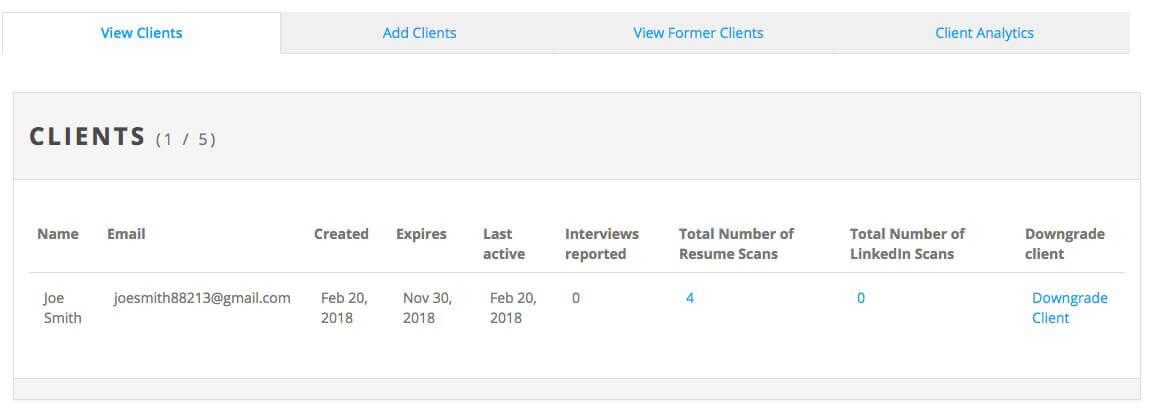
Jobscan has launched Jobscan Coach, a platform that helps employment specialists manage their clients as they guide them to an optimized resume with Jobscan. Check out some of the features in the Jobscan Coach tutorial.
Career coaches serve as a lifeline for anyone unhappy in their work or struggling to gain traction in their job search. We are huge fans and supporters of the work they do and hope that both Jobscan and Jobscan Coach are positive contributions to their toolkit.
We asked five career coaches about the other tools they rely on, including both resources for their clients and the tools they use to keep their coaching businesses running efficiently:
Erin Ewart

I help social sector professionals find and land jobs they love. Drawing on my 15+ years of experience as a recruiter in the private and nonprofit sectors, I provide action-oriented coaching, tools and feedback to help my clients create a job search strategy that works. I work on all aspects of the job search process, from identifying strengths and career goals to updating resumes and LinkedIn profiles to interview preparation and offer negotiation.
Here are a few tools I often recommend to my clients. These and additional recommendations are listed on on my website.
If you’re not yet clear on your top strengths, my favorite assessment is StrengthsFinder. Understanding what you’re best at is crucial to finding a job that will be the best fit for you as well as to effectively communicating what you can bring to a role. The StrengthsFinder Top 5 assessment is only $20 to take online and gives you immediate results that you can use to better understand and talk about your skills and strengths. There are also many companion tools and resources available online to help you interpret and use your results.
Once you’re ready to implement your job search, it’s important to treat it like any other project and use good tools for time and information management. A simple Google or Excel spreadsheet tracker will help you track networking contacts, job applications, and follow ups. You should track your time to make sure you’re spending most of it on proactive outreach and networking (this should be about 80% of your job search time). I recommend Toggl for time tracking, and use it myself to keep track of all of my work. I also encourage my clients to set weekly, monthly and quarterly goals using the SMART goal framework.
Finally, if you’re looking for a longer read, Designing Your Life is a great book with activities and exercises focused on aligning your career and life goals. It’s especially helpful if you aren’t clear on what you want to do or are struggling to choose between different paths and can help you break out of feeling “stuck” with where to go next.
Kyle Elliott
 People reach out to CaffeinatedKyle.com when they need support navigating a career transition. They may have found themselves unemployed, underpaid or just bored with their current work, and are looking for someone to guide them through the job search process. I help these job seekers identify their strengths and passion, clarify their goals, and most importantly, find jobs they LOVE (or at least tolerate).
One of the best tools I have found for job searching is Streak, a CRM directly in your inbox. As a coach, I use Steak to manage outreach and communication with clients. My clients use Streak to stay organized throughout the entire job search process, so they spend less time on the administrative tasks and more time where it matters — applying to jobs and networking.
Beyond Streak, I continually encourage clients to use the video camera on their phone or laptop. It’s important to practice your elevator pitch and there is no better way to do that than to record yourself, then watch it! Watching yourself on video can feel strange at first, but you’ll get used to it over time. I promise.
Job searching is often a labor-intensive and time-consuming process. I continually find ways to helps clients make the job search process as stress-free and efficient as possible. I’m not saying the journey is easy, but I am committed to removing roadblocks and ensuring job seekers are working smarter, not harder.
Ruth Kunstadter
 Coming from the fields of education and nonprofit, I have always had a mission to connect people to their passion, purpose and highest potential – and to the internal strengths and external resources that will make that happen. I am always on the lookout for creative and useful resources, and I recommend and use many career search tools in my work.
First of all, I have definitely recommended Jobscan! It’s such an excellent visual representation of how closely a person’s resume matches the job description. For individuals who, like me, are very visual, this is very helpful – and very direct.
With regard to other tools – I like this free, online career assessment from O*Net. It’s similar to the Strong Interest Inventory (it gives you your Holland codes) and gave me the same results. I work with individuals who are entering, re-entering, or undertaking some sort of transition in the workforce – whether voluntary (they want more meaningful work) or involuntary (they have been unemployed – and of course, still want meaningful work!). The results from this test give us lots to dig into.
I have also recommended that clients use JibberJobber to track their job search progress (although most of my clients use some version of Excel). In the work I do as a volunteer career coach through the New Start Career Network (part of Rutgers University’s John J. Heldrich Center for Workforce Development), our clients have free access to resources such as Optimal Resume, Career Shift and Vault, which are provided to NSCN members courtesy of Rutgers University Career Services. Career Shift and Vault are mostly for researching companies, and this has been useful for some.

Bianca J. Jackson
 I empower women, especially those in tech, with the tools and confidence to get what they want from their careers and lives, so there’s no struggle for “work-life balance,” there’s just balance. My particular expertise is helping them build their personal brand. We discuss how to best position them and how to use tools like LinkedIn to target and attract the right opportunities.
When looking for your next career opportunity, having a positioning strategy that works is key. Gone are the days where you just update your resume and throw into the job search pond as bait to land a big fish aka “your dream job.”
Each day, I roll around with my laptop, phone, and pocket juice (mobile battery charger) as my physical tools.
For software and mobile apps, I use the following:
- I swear by LinkedIn. It is an amazing tool for job seekers and entrepreneurs who want to connect with people and build relationships.
- Buffer helps me keep my social media channels in check.
- Pandadoc for proposals and reports.
- Canva to make quick graphics and presentations on the go.
- Paypal and Wave to keep the money straight.
- MailChimp for sending my daily emails of career inspiration.
Wendy Haylett
 My career coaching has evolved over three decades in the industry. As one of the first members of the Professional Association of Resume Writers and Career Coaches (PARWCC), I started in the industry during its evolution from resume preparation as a typing or secretarial service to the strategic resume writing and career coaching industry it is now. I offer coaching in career planning and management, career transition, second or encore careers, leadership development, LinkedIn networking, strategic job search, and mindfulness coaching.
I consistently sought professional development through membership associations and contributions to PARWCC, ProfilingPro, The National Resume Writers Association (NRWA), Career Planning and Adult Development Network, and Jay Block’s 5 Steps to Rapid Employment Certification Program. I consider each of these organizations as the most important tools that make my work possible. Without the knowledge and camaraderie of my mentors and colleagues, I would not have a business.
Some of my other top tools are:
- Assessments I provide to my clients through ProfilingPro: Values & Motivators , DISC Communication; Behavioral Strengths, DISC Career Management, DISC360 , SalesIQ.
- The top books I recommend to clients: PeopleSmart by Tony Alessandra, Ph.D. and Michael J. O’Connor, Ph.D.; The Art of Taking Action: Lessons from Japanese Psychology by Gregg Krech; 5 Steps to Rapid Employment by Jay Block
- Zoom video conferencing for client coaching sessions.
- YouCanBook.me for live web-based client scheduling.
- Hootsuite for social media scheduling and publishing.
- Toodledo for project scheduling.
Thank you for sharing your top career coach tools!